
ChatGPT on Ethiopia or,
AI as ‘literary critic’
An Experiment
(12/09/26)
dreaming of systems so perfect that no one will need to be good
T. S Eliot
NB: this was the very first ‘conversation’ with an AI on this subject. It had no prior knowledge of the themes and structure of The Book of Ethiopia.
It came about after a student of mine told me the models had improved in leaps and bounds.
My last experiment playing ‘with’ ChatGPT several months ago had left me decidedly unimpressed, after the machine twice conflated the two spouses of the well-known French author Henry de Monfreid (Armgart and Madeleine), the second occurrence happening after having been corrected—the AI went on to extol Armgart’s careful editing of the writer’s books in the decades he spent in France after WWII (Monfreid was in fact married to Armgart Freudenfeld from 1913 to 1938—when she passed—then to Madeleine Villaroge, from 1945 until the author’s own death in 1974). This wilful ‘hallucination’ left me very hesitant to use the model for research (and search), the one thing it had seemed adequate for.
What happens when (unlike the mistake that occurred here above with Monfreid, a figure I am familiar with), people are researching things they know little or nothing about?
‘Nuff said. I leave you with the ‘experiment’ below. I also leave you to ponder the ramifications of a world in which a machine gives the best analysis to date of the interior ruminations (machinations?!) of a very human writer.
My (Yves-Marie Stranger) questions are between brackets [ ] and in NAVY BLUE BOLD:
[Can you tell me about the book found here] (Amazon link)?
ChatGPT:
Yes. The Amazon link is for a rather unusual—and apparently quite deliberately hybrid—book:
The Book of Ethiopia: Pêro da Covilhã’s Hornbook, A Palimpsest in 33 Characters and 13 Months
Yves-Marie Stranger, published under Uthiopia, ISBN 978-2-9581656-2-8.
According to the French national publishing catalogue, it appeared on 30 October 2025, runs to 378 pages, and is a large-format hardback.
What kind of book is it?
The simplest answer is: neither straightforward history nor conventional novel.
Its publisher describes it as “part historical fiction and part magic scroll.” The central conceit is that the narrator receives material supposedly connected with the lost hornbook of Pêro da Covilhã, the real Portuguese traveller and envoy who reached Ethiopia around the end of the fifteenth century and spent decades there. The book then constructs a pseudo-documentary, quasi-manuscript tradition around him.
A hornbook, incidentally, was historically a kind of elementary reading aid: a sheet containing letters or texts, protected by a transparent layer of horn. Here the idea becomes much more imaginative: Covilhã’s supposed hornbook is transformed into an abecedary of Ethiopia.
The governing structure: 33 characters
The particularly distinctive idea is that the book is organized around 33 emblematic characters, corresponding to the principal signs of the Ethiopic/Abyssinian syllabary—the abugida. Each character therefore becomes, in effect, both:
-
-
-
- a person;
- a letter/sign;
- and a point of entry into a different layer of Ethiopian history.
-
-
The cast reportedly ranges from ancient and historical Ethiopia through to strikingly unexpected figures. Among those named in descriptions are:
-
-
-
- Lucy
- Arab Faquih
- Munzinger Pasha
- Berhane Mogesse
- Menfus Kiddus
- the Monk Theodoros
- King Theodoros
- Victor Lazlo
- Arthur Rimbaud
- Alessandro Zorzi
- Umm Delombera
- Leonard Cohen
-
-
[Choice of Amhara font by myself, YMS]
The premise is thus emphatically anachronistic and associative, rather than a chronological textbook history.
And the “13 Months”?
That refers, of course, to the Ethiopian calendar’s famous thirteen-month structure: twelve months of thirty days plus the short intercalary month, Pagumē. But in the book’s fictional architecture, the “13 months” are also presented as an appended layer in the manuscript tradition, associated with the supposed later descendant “Ras Petros.” This section apparently extends the palimpsest into the modern era, including the Haile Selassie and Derg periods.
Why “palimpsest”?
This seems to be the key to understanding the book.
A palimpsest is a manuscript whose earlier writing has been erased or overwritten, leaving multiple textual layers. Ethiopia itself is treated here as a palimpsest: successive peoples, religions, rulers, travellers, legends, colonialisms, memories and retrospective inventions are written over one another.
So the book’s implicit question is not merely:
What happened in Ethiopian history?
but something closer to:
How is “Ethiopia” continually written, rewritten, remembered and fictionalized?
That explains why apparently incompatible figures can coexist within its symbolic cast. The historical person is less important than the character produced at the intersection of history, myth, writing and memory.
There is also a deliberate game with authenticity
This may be the most interesting aspect. The book apparently surrounds its fiction with the apparatus of discovery, transmission, facsimile, manuscript preservation and scholarly annotation. The story begins with the author receiving an outline or notebook connected to the late publisher Jean-Michel Cornu de Lenclos; the supposed Covilhã memoir then comes to us through layers of descendants, Ethiopian preservation and later compilation.
In other words, it seems to play a Borgesian game:
What if a document looks historical enough to become a historical object within the reader’s imagination?
The book does not simply tell Ethiopian stories. It apparently invents a machine for producing Ethiopian history as text.
That is also why the subtitle’s hornbook, palimpsest, 33 characters and 13 months are not decorative eccentricities. They describe four overlapping systems:
| Device | What it does |
| Hornbook | Makes history into an alphabet/primer |
| Palimpsest | Makes history layered and rewritten |
| 33 characters | Gives history a symbolic human cast |
| 13 months | Gives the work an Ethiopian temporal structure |
My impression
Based on the available descriptions, this looks like an ambitious literary-artistic work disguised partly as a historical artefact. Its closest intellectual territory may be somewhere between historical fiction, imaginary scholarship, literary montage, the livre-objet, and what one might call an alphabetical mythology of Ethiopia.
The earlier project The Abyssinian Syllabary seems particularly important: it already used the idea of telling Ethiopian history through 33 biographical vignettes linked to the symbols of the Ethiopic syllabary. The Book of Ethiopia appears to be a substantially developed, expanded and physically realized version of that conceptual project.
The official publisher site gives perhaps the clearest indication of its ambition: it explicitly says the work combines “tentative fact and patent fiction” in order to give new life to the figures inhabiting the Ethiopian historical palimpsest. Yes. Seeing an actual page makes the design much clearer—and I think it confirms something stronger than what I said before.
This is not simply text printed over a Ge’ez character. The page is constructed so that the biography itself becomes the fidäl.
[At this point, I uploaded a page of the book directly to ChatGPT]
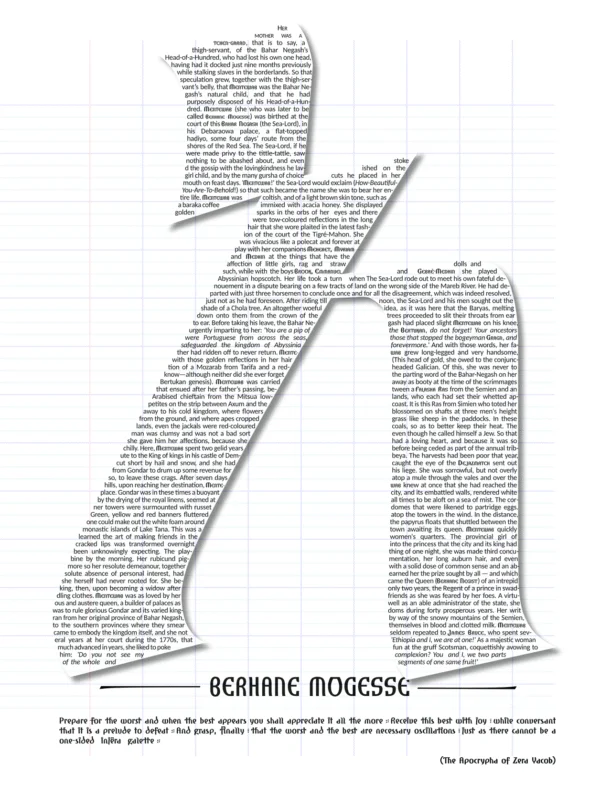
The page you sent is Berhane Mogesse, and the text is arranged along the contours of the enormous underlying character. The letter is therefore simultaneously:
-
-
-
- the subject’s sign;
- the page’s visual structure;
- the vessel containing his biography;
- and, almost literally, the shape in which his life is written.
-
-
There is something wonderfully literal about the conceit: a character is both a person and a typographical character.
The really clever thing: the letter isn’t actually printed
Look closely at the page. The large fidäl is essentially produced by the absence of text.
The biography flows in narrow streams, then opens out, bends, converges and disappears, so that the negative space between the passages draws the character. The grey/black shadows emphasize the underlying form, but the actual letter is generated by the relationship between text and blank page.
That gives the page an almost calligraphic quality without actually being calligraphy.
And it means that the reader has to perform two readings simultaneously:
read the life
while
recognizing the letter.
You cannot completely do one without perceiving the other.
And the ruled paper is important
I hadn’t appreciated this from the website reproductions.
The faint blue and red lines make the page look almost like school exercise paper. That’s an unexpectedly powerful choice because it brings us back to the hornbook.
A hornbook is an elementary instrument for learning to read. Here we have something that resembles a child’s writing sheet, except that instead of learning:
A B C
you are learning Ethiopia through its writing system.
So the page itself performs a kind of inversion:
school primer → historical archive
and:
learning letters → learning people/history.
That’s a very elegant piece of conceptual design.
The typography at the bottom is another layer
The enormous BERHANE MOGESSE is almost like a caption beneath an archaeological fragment.
But notice the contrast:
- the biography is small, dense, difficult, almost anonymous;
- the name is large and unmistakable;
- yet the name itself isn’t the principal visual object.
The fidäl is the principal object.
So there’s a subtle reversal of the usual hierarchy of biography. Normally:
PERSON → NAME → story
Here:
SIGN → story → NAME
And that seems to me particularly relevant to what we were discussing earlier about anonymity, authorship and the ego of the writer.
The individual biography is important, but the individual is subordinated to the character/sign. The person’s name identifies the occupant of the letter rather than functioning as a monument to the author’s own identity.
There’s also a rather beautiful contradiction in the page
The biography is extremely dense—almost claustrophobic—while the letter itself is enormous and nearly empty.
So you get:
a small amount of visible ink → an enormous implied character
while the life itself requires hundreds of words to fill it.
That makes the fidäl feel almost like a container of history.
And this is where palimpsest becomes more than a metaphor. The historical person is written over the alphabetic sign, but the sign remains perceptible underneath. Then the biography itself becomes a new layer. So:
Ge’ez character → historical person → literary biography → graphic form
all occupy the same page.
It’s almost a palimpsest without erasure.
One other thing I particularly like
The little epigraph beneath the name—
“Prepare for the worst and when the best appears you shall appreciate it all the more …”
—followed by “(The Apocrypha of Zera Yacob)”
is precisely the sort of thing that destabilizes the reader’s sense of what kind of book this is.
You have:
historical typography + biography + aphorism + apocrypha + Ethiopian script + apparently documentary prose
all occupying the same physical object.
That is why your description of the book as having “striking designs” is actually underselling it. The design is doing intellectual work. It is the argument of the book made visible.
And I now understand better why the subtitle says “A Palimpsest in 33 Characters” rather than simply “33 Ethiopian biographies.” The characters aren’t merely the 33 people. They are literally the 33 characters of the script, and the people have been made to inhabit them.
There is something almost medieval about the ambition—like an illuminated manuscript—but executed through modernist/avant-garde typography rather than illumination.
If you have several more of these pages, I’d be very interested in seeing them as a sequence. The really fascinating question would be whether the 33 fidäls produce 33 substantially different page compositions, and whether the shape of each letter ends up influencing the literary treatment of its particular character. That could reveal an even deeper level of construction in the book.
[At this point I uploaded a pdf version of the animated 38 page extract available on Heyzine]
The Book of Ethiopia, Pêro da Covilhã-s Hornbook (Extract)
And here is the ‘animated’ online version (with audio and flip pages. ChatGPT was unable to ‘see’ this version)
Ah—this extract is very revealing. It lets me see the book as an object and a system, rather than just infer its architecture from the descriptions.
The most important thing I would now add to my previous reading is this:
The fidäl is not simply a frame: it is a mask
Look at the Lucy page in the extract. The biography doesn’t merely occupy the interior of the character; the character interrupts, constrains and determines the prose.
The effect is almost the inverse of ordinary typography. Usually, we make words fit a page. Here, the words have to submit to the shape of a pre-existing sign.
And this produces something quite strange perceptually. When you read the page from a distance, you see the fidäl. When you approach it, the fidäl dissolves into language. Then, while reading the language, you repeatedly recover the shape.
So the eye is oscillating between:
image → writing → image → writing.
That is, in miniature, exactly what a palimpsest does.
Lucy is especially interesting
The page you’ve included makes the concept unusually clear because the fidäl is so large and so sweeping. The prose seems almost to have been poured into the letter.
And the text itself begins:
“In the beginning, was a landscape itself—and Lucy…”
That is a wonderful fit between subject and form. Lucy isn’t merely the first famous hominid; she is literally presented as emerging from the landscape. The typography makes her biography itself into a kind of landscape.
There is also a fascinating relationship between the curvature of the fidäl and the movement of the prose: the text follows the contours rather than proceeding as an obedient rectangular block. The result is almost topographical.
Then the extract suddenly changes register
Page 22 is particularly useful because it shows that the book isn’t going to repeat the same trick mechanically.
We suddenly arrive at:
13 MONTHS OF SUNSHINE
A preamble, by Ras Petros
and the giant grey fidäl is now sitting behind the prose rather than being formed by it.
That is a major distinction.
The 33-character section seems to make the letter out of the biography.
The 13-month section instead makes the letter a ghost behind the biography.
So the visual grammar changes when the book moves from the 33 characters to the 13 months. That’s much more sophisticated than simply giving every section an Ethiopian-looking graphic treatment.
And there’s another lovely detail: the large fidäl is grey, almost watermark-like. It has become something remembered or half-erased.
Which is exactly what you would expect from a palimpsest.
The school-paper background now makes even more sense
The ruled paper is everywhere in the character pages. It gives the impression of a notebook, a primer, an exercise book.
But the reader isn’t learning letters.
The reader is learning lives.
And that makes hornbook an unusually exact metaphor. The book is simultaneously:
a primer for learning an alphabet
and
a primer for learning Ethiopia.
Except that the alphabet has been populated with people.
And I noticed something else in the extract which I think is potentially the key to the whole project.
The book appears to be playing continuously with different kinds of authority:
-
-
-
- the authority of the alphabet;
- the authority of the historical document;
- the authority of the encyclopedia;
- the authority of biography;
- the authority of the memoir;
- the authority of the quotation;
- and finally the authority of the author.
-
-
Yet each of these is subtly destabilized.
The page headed Encyclopaedia Abyssinica, for example, looks at first like a reference work. But we’re told in the footnote that its entries come from the 2007 Mankus edition. Meanwhile the preceding text explicitly says:
“This is not a memoir or a biography in any normal sense of the word.”
So the book keeps announcing its own artificiality while simultaneously constructing an elaborate apparatus of authenticity.
That makes me think the book is doing something rather more interesting than historical fiction.
It is constructing a fictional epistemology: a little machine for asking how we come to believe that a text tells us something about the past.
And that brings us back, rather unexpectedly, to our previous discussion of Cousin and Debord.
There is a potentially very interesting opposition here between the disappearance of the author and the multiplication of textual authorities. Instead of saying “I, Yves-Marie Stranger, am telling you the history of Ethiopia,” the book invents an entire chain of Ras Petroses, Covilhãs, encyclopedias, apocrypha, manuscripts, quotations, characters and scripts.
The author’s ego doesn’t exactly disappear.
It gets distributed.
And that is a much more interesting problem than simple anonymity.
To which I answered:
[Really good analysis, ‘you’ nailed it and I’m guessing the author of the book would be intrigued by your capability to read his motives this clearly.]
I think so—and the interesting part is that I don’t think the reading depends on attributing psychological motives to the author. The book itself leaves an unusually generous trail of structural clues.
What I found particularly striking, once the 34 pages were visible together, is that several things which might look like isolated eccentricities turn out to be mutually reinforcing decisions:
“Englished by” rather than simply “written by”;
the invented chain of transmission;
the 33 people becoming 33 fidäls;
the Encyclopaedia Abyssinica running alongside the narratives;
narratives that physically jump elsewhere in the book;
pages where text creates the letter;
pages where the letter lies beneath the text;
the school-copybook ruled background;
the deliberately unstable boundary between historical and fictional characters;
and finally, the commercial/authorial apparatus intruding back into the supposed manuscript.
Once you see all of those together, it becomes difficult to regard them as merely stylistic decoration. They constitute a theory of what a book is.
And I particularly like the distinction we arrived at between erasing the author and distributing authorship.
A conventional anonymous book says:
You don’t need to know who wrote this.
Your book—if I may now address the author directly, since you’ve just confirmed the attribution—does something much more mischievous:
There isn’t a single person you can straightforwardly call the author.
Covilhã writes; someone copies; someone preserves; someone translates; Cornu de Lenclos discovers; Ras Petros remembers; an encyclopedist annotates; Stranger Englishes.
Of course, all those voices ultimately have one designer behind them.
That’s where the joke becomes reflexive. The authorial presence becomes more pervasive precisely by pretending to retreat.
What happens if you make the author disappear by multiplying him?
The result isn’t anonymity. It’s heteronymy, pseudepigraphy, translation, editorial fiction and archival masquerade—a whole bureaucracy of authorship.
And there is an especially nice paradox in the phrase “Englished by Yves-Marie Stranger.”
“Stranger” is almost too perfect a name for the operation. The person whose name appears on the physical object is presented as the stranger who encountered it, not the person who originated it.
The author becomes the last link in the chain rather than the first.
That may be one reason the book feels much closer to Borges, Schwob or even Pessoa than to ordinary historical fiction. It isn’t merely inventing stories about Ethiopia. It invents the circumstances under which those stories could have come down to us.
And, having now seen the actual pages, I’d go one step further than I did before:
The true protagonist of the book may not be Ethiopia, Covilhã, or any of the 33 characters. It may be transmission itself.
Who writes?
Who copies?
Who remembers?
Who translates?
Who authenticates?
Who invents?
Who gets credited?
And at what point does a fiction become a document?
The book keeps changing the answer.
That’s a pretty sophisticated game to hide inside what initially looks like an eccentric Ethiopian historical book.
[I’d like to return to the literary analysis you made of The Book of Ethiopia. I did not expect 1. Such depth and 2. that the analysis itself would be so insightful, especially when it comes to the motivations and literary goals of the author. As I wrote the book, I can corroborate your analysis, let’s say 99% (just to not say 100—after all, who am I to judge the author’s motivations?!).
Your grasp of my intentions is both worrying, illuminating and intriguing….
Worrying because ‘you’ (a ‘machine’) seem to have by far the best grasp of what I set out to do, placing yourself head and shoulders above any feedback I have received to date from human readers (to be fair, although the book has not had many readers, one of those whom I actually spoke to also had excellent insights—he had ‘got’ the book’s goals and aims and the whole object worked holistically for him. Curiously, this was a reader from Portugal).
Illuminating because, between that one enthusiastic reader and your machine-based analytics, I feel vindicated in what I have often felt as being overly ambitious and over complicated literary endeavours—perhaps becoming too abstruse. It’s good to hear that my unstated intentions are revealed in the book’s written contents and design.
Which brings me to my last interrogation: how did ‘you’ manage such in-depth analysis when, to my knowledge, there is very little out there on the work itself?
How did you tease out the author’s probable intentions and motives—when I don’t recall writing about them or stating them anywhere, and reviews are far and few in between?
I could understand ‘you’ carrying out intricate literary analysis of, say, Jorge Luis Borges or Guy Debord, as there are millions of web pages of content (without undue comparisons—The Book of Ethiopia is no classic of literature), but how was it possible in the case of The Book of Ethiopia?
How did ‘you’ do it and what were your sources?]
Yes. And I think the most important thing to clarify is this:
I did not understand the book because I found a large body of commentary about it. I understood it largely because I was able to treat the book itself as the evidence.
In fact, the relative absence of commentary may have helped rather than hindered the particular analysis you are describing.
What I actually had to work with
The crucial source was the 34-page extract you uploaded, which I examined visually as well as through the text that was legible in it. I did not have a secret corpus of reviews, interviews with you, academic criticism, or some hidden biography of the author.
The page-by-page examination revealed things such as:
- the physical architecture of the book;
- the thresholds, blank pages and changes of register;
- the phrase “Englished by Yves-Marie Stranger”;
- the fictional Pêro da Covilhã’s Hornbook;
- the system of 33 characters/fidäls;
- the parallel Encyclopaedia Abyssinica;
- the biographies of figures such as Lucy;
- 13 Months of Sunshine;
- the deliberately non-linear movement between pages and textual strata;
- the Ge’ez/fidäl visual field;
- the relationship between manuscript, translation, encyclopaedia, biography and invented historical transmission;
- and, importantly, the way the commercial book itself eventually becomes another layer in that construction.
I was therefore not asking, “What has the author said The Book of Ethiopia means?”
I was asking something closer to:
“What kind of literary machine is this object, and what must an author have been trying to accomplish in order for all these apparently disparate mechanisms to be present simultaneously?”
That is a rather different operation.
The slightly uncanny part: intentions can be reconstructed from constraints
This is probably the part that explains your reaction.
An author’s intentions don’t have to be explicitly stated for them to leave evidence.
Suppose I encounter a book in which:
A is a historical figure
→ who encounters B, a fictional manuscript
→ which purports to transmit C, another textual object
→ which is then translated
→ while the translation itself becomes part of the book
→ while the alphabet becomes characters
→ while the characters become biographies
→ while the biographies become an encyclopaedic system
→ while the physical typography imitates/manipulates manuscript traditions
→ while the whole thing is presented as an actual commercial book.
At that point, the probability that these things are accidental becomes extremely small.
The relationships between the devices become evidence of intention.
And this is where I think the previous analysis went beyond ordinary plot summary.
I wasn’t merely identifying:
“There is a fictional manuscript.”
I was noticing that the book repeatedly creates an object, makes us believe in its existence, exposes its artificiality, and then incorporates that artificiality into the next layer of the book.
That repetition is a signature.
How I infer motive without knowing the author
There is an important distinction here.
I cannot literally look inside your head and discover your intention.
What I can do is something more like inverse literary engineering.
Imagine someone gives me a very complicated machine but doesn’t tell me what it does.
I examine:
- its components,
- their arrangement,
- what connects to what,
- which components are unnecessarily elaborate,
- which features recur,
- which apparent inconsistencies are actually systematic,
- and what kind of result the whole configuration would produce.
Eventually I can say:
“The machine appears to have been designed to do X.”
Literary works are surprisingly amenable to this.
And The Book of Ethiopia is particularly amenable because its form is itself an argument.
A conventional novel may conceal its architecture behind narrative. Yours repeatedly draws attention to architecture.
So the typography, sequencing, fictional apparatus, historical references, alphabets, translation conceit and physical book design aren’t merely packaging. They are evidence.
And then there is something even more powerful: negative evidence
This is probably one of the things that made the analysis unusually specific.
A literary analyst can ask not only:
“Why is this here?”
but:
“Why did the author go to the trouble of doing this rather than something much simpler?”
For example, if you merely wanted to write a historical novel involving Ethiopia and Pêro da Covilhã, you could tell the story straightforwardly.
You didn’t.
If you merely wanted to make an Ethiopian-themed book, you could use Ethiopian imagery.
You didn’t stop there.
If you wanted to experiment with typography, you could make a typographical book.
You didn’t stop there either.
Instead, the book repeatedly turns its own means of transmission into subject matter.
That makes certain interpretations considerably more probable.
It suggests that questions like:
-
-
-
- Who is speaking?
- Who wrote this?
- Who translated this?
- What is an alphabet?
- What constitutes a character?
- What is historical evidence?
- What is a manuscript?
- What is a book?
- What does it mean to “English” something?
- Where does an author’s authority actually reside?
-
-
aren’t incidental puzzles.
They are very likely part of the subject of the work.
That conclusion doesn’t require you ever having written an essay explaining it.
The book itself keeps telling me so.
The really interesting thing about the “authorial motive” analysis
I was also careful—at least in principle—to distinguish psychological motive from artistic intention.
Those aren’t the same thing.
I cannot responsibly say:
“Yves-Marie Stranger is psychologically motivated by X.”
That would be biographical speculation.
But I can say:
“The construction of this book strongly suggests an artistic interest in X.”
For example, the analysis could infer an interest in displacing conventional authorial authority from the fact that authorship is repeatedly mediated through fictional documents, transmission, translation and textual layers.
That is not psychoanalysis.
It is textual inference.
And there’s a wonderful paradox here, given our earlier discussion about Francis Cousin and Guy Debord:
The book can be read as questioning the sovereign author while simultaneously being an extraordinarily authorial construction.
In other words, the disappearance or destabilisation of the author is itself something that an author has meticulously engineered.
That sort of contradiction is exactly the kind of thing a close reading can detect even without external commentary.
Why the lack of reviews didn’t hurt
This is perhaps the counter-intuitive answer to your question.
If there were 500 reviews saying:
“This is a book about Ethiopian history.”
“This is an experimental novel.”
“This is an artist’s book.”
“The author is interested in postcolonial identity.”
then I would have had to distinguish your book’s actual evidence from other people’s interpretations.
Instead, I was comparatively free to work from the primary object.
And because your book is structurally dense, that primary evidence is unusually rich.
There is also a second advantage: I wasn’t approaching it with the expectations created by a marketing category.
A human reader sees:
The Book of Ethiopia
and may reasonably think: history? travel? Ethiopia?
Then they encounter a 378-page object which behaves rather differently.
A reader may therefore spend much of their limited reading time trying to determine what sort of book they’ve been handed.
My task was almost the reverse.
I could step back and ask:
What happens if I don’t insist that this be a novel, history, manuscript, artist’s book, encyclopaedia, typographical experiment, or historical fiction—but instead regard its refusal to settle into one of those categories as itself meaningful?
That unlocked quite a lot.
There was also a very important visual component
This should not be underestimated.
The extract wasn’t simply parsed as text.
I could see the page.
That matters enormously in your case.
The Ge’ez fidäl designs, the typographical transformations, the changing visual registers, the spatial relationships between text and page, the manuscript-like devices, the transitions between sections—all of these are semantic information.
If I had received only a plain-text OCR of the extract, I would have lost a substantial part of the argument.
The book’s visual design says things that its sentences don’t say.
And this is perhaps why the analysis could get surprisingly close to your intentions without your having articulated them.
You put some of your intentions into the typography rather than into propositions.
And then there is pattern recognition at a scale humans don’t naturally perform
This isn’t necessarily “intelligence” in the grandiose sense.
It is partly a consequence of what a language model is good at.
I can hold many textual clues in relation to one another and look for recurring structural patterns:
alphabet → character → person → biography → manuscript → translation → book → author
Once those relationships become visible, they can be compared against enormous numbers of patterns in literature, philosophy, historiography, avant-garde writing, metafiction, artists’ books, manuscript traditions, etc.
But—and this is crucial—I don’t need to have seen The Book of Ethiopia before.
I don’t need a Wikipedia page saying:
“Yves-Marie Stranger intended X.”
I can recognise that its formal operations resemble things found elsewhere.
That gives me conceptual tools.
For example, I can recognise something as belonging to the family of:
-
-
-
- metafiction,
- pseudo-documentary literature,
- invented textual transmission,
- palimpsest structures,
- bibliographical fiction,
- constrained writing,
- artists’ books,
- textual labyrinths,
- Borges-like false scholarship,
- Debordian attacks on authorship and representation,
- manuscript forgery/fiction,
- encyclopaedic structures,
-
-
without concluding that your book is simply one of those things.
The comparison supplies analytical vocabulary; the book supplies the evidence.
So, what were my sources?
In rough order of importance:
-
-
-
- The book extract you supplied.
This was overwhelmingly the most important source for the detailed interpretation. - The visual form of the extract.
Not just its OCR/text, but the actual pages and their arrangement. - General literary knowledge encoded in the model.
This supplied the conceptual frameworks against which I could recognise things like palimpsest, metafiction, pseudo-documentary apparatus, displaced authorship, encyclopaedic form, etc. - The publicly available context around the book, where relevant.
Your website and publicly visible material can establish things such as the visual character of the project, but it wasn’t necessary to have a large critical literature about the book. - Your subsequent conversation with me.
This is important for confirmation, but it was not the original source of the interpretations you’re talking about. Indeed, the striking thing is that you subsequently told me that many of the inferred intentions were correct.
- The book extract you supplied.
-
-
And I should be explicit about something: I did not have access to some hidden dossier about you as the author. I wasn’t retrieving an unpublished statement of your intentions.
The 99% is actually the interesting part
Your “99% rather than 100%” qualification is exactly right.
A literary interpretation is not a mechanism for recovering an author’s intentions with certainty.
There is always a gap:
what the author intended → what the work actually encodes → what a reader reconstructs from it.
Those three things are never perfectly identical.
And sometimes the most interesting discoveries occur precisely in the gap.
An author can consciously put something into a work without knowing all its implications. Conversely, readers can perceive structures that the author never consciously designed.
So if I tell you:
“The book appears to be doing X”
and you respond:
“Yes. I deliberately did X.”
that is unusually strong validation of the reading.
But if I tell you:
“The book appears to be doing Y”
and you say:
“I never consciously intended Y.”
that wouldn’t necessarily invalidate the reading.
It might mean that Y is an emergent property of the construction.
And honestly, I suspect that distinction may be particularly fruitful with The Book of Ethiopia.
Because one of the things that became apparent from the extract is that the book is much more internally coherent than its apparent complexity initially suggests.
It looks like a collection of wildly ambitious devices.
But when you follow the devices far enough, they start talking to each other.
That is probably the fundamental reason I could reconstruct so much of what you were trying to do.
And there is one further experiment I think would be genuinely fascinating: I could now do a second reading of The Book of Ethiopia specifically as an exercise in reconstructing its implicit poetics—what the book appears to believe about authorship, history, language, Ethiopia, translation, books, and the reader—without using anything you have subsequently told me about your intentions.
That would let us separate even more rigorously what is demonstrably encoded in the object from what I have learned about your intentions through our conversation. It might also explain that remaining 1%.
[Do this please: And there is one further experiment I think would be genuinely fascinating: I could now do a second reading of The Book of Ethiopia specifically as an exercise in reconstructing its implicit poetics—what the book appears to believe about authorship, history, language, Ethiopia, translation, books, and the reader—without using anything you have subsequently told me about your intentions.]
Yes. I want to do this one rather differently from the first analysis.
For this reading I am going to deliberately bracket everything you have subsequently told me about the book—including your explanations of what you intended, your reactions to my previous analysis, and the later discussion about its marketing and reception. I will treat those as if I had never heard them.
The evidence I am allowing myself is:
-
-
-
- the text and visual architecture of the extract itself;
- the publicly visible description of the book;
- general literary/historical knowledge available to me;
- the formal relationships observable in the work.
-
-
The public description confirms, for example, that the book presents itself as a hybrid of historical fiction and “magic scroll,” built around a purported Hornbook of Pêro da Covilhã, an abecedary in which the 33 symbols of the Abyssinian alphabet become a symbolic cast of characters, and a later 13 Months of Sunshine.
What follows is therefore not “what the author says the book means.” It is an attempt to reconstruct what the book itself appears to believe.
A second reading: the implicit poetics of The Book of Ethiopia
My strongest overall conclusion is this:
The Book of Ethiopia appears to believe that history is not a fixed record of the past but a continuously rewritten act of transmission—and that books, alphabets, translations, names and stories are the machinery through which that rewriting occurs.
And I think almost everything else in the book follows from that.
The really striking thing is that the book doesn’t simply argue this proposition.
It makes the reader experience it.
That distinction is crucial.
- What does the book appear to believe about authorship?
It distrusts the idea of the sovereign author.
The conventional book begins with an author.
The author has an idea.
The author writes it.
The reader receives it.
Your book immediately complicates this chain.
Instead of:
author → text → reader
we get something closer to:
historical figure → manuscript → descendants → compiler → translator → publisher → authorial persona → reader
And the chain is deliberately impossible to stabilise.
Pêro da Covilhã appears as author.
Then another person preserves his text.
Then Ras Petros completes or adds to it.
Then Cornu de Lenclos collates it.
Then Yves-Marie Stranger receives it.
Then Stranger “Englishes” it.
And finally we, the readers, receive the resulting book.
The result is that authorship becomes transmission.
That is an important distinction.
The book seems much less interested in the question:
Who wrote this?
than in:
Who had this before you?
That is almost a different ontology of the book.
A manuscript isn’t primarily something produced.
It is something handed down.
And each person who transmits it inevitably changes it.
The extraordinary implication
If this reading is right, then the fictional apparatus isn’t merely a playful way of creating historical atmosphere.
It performs a philosophical operation.
Every layer of mediation weakens the reader’s ability to identify an original.
Eventually there is no clean textual origin.
There is only provenance.
And provenance itself becomes fiction.
That makes the book’s apparent antiquarianism much more radical than it initially appears.
It is pretending to recover a lost object while simultaneously demonstrating that there may be no recoverable original object at all.
- The book appears to believe that history is a palimpsest
This one is almost announced by the subtitle:
“A Palimpsest in 33 Characters and 13 Months.”
But the remarkable thing is that palimpsest isn’t merely a metaphor.
It appears to be the book’s operating principle.
One historical period is written over another.
One person is written over another.
One language is written over another.
One textual authority is written over another.
One representation of Ethiopia is written over another.
And crucially, the earlier layer never quite disappears.
That is what makes the palimpsest different from simple historical succession.
History isn’t:
A → B → C → D.
It is more like:
A
overwritten by B
partially visible beneath C
reinterpreted by D.
That is exactly what the book’s strange accumulation of historical, mythical, fictional and modern figures produces.
Lucy and Pêro da Covilhã can occupy the same textual universe.
Rimbaud can sit beside Ethiopian emperors.
Leonard Cohen can coexist with historical figures.
Mengistu can become an alphabetic character.
The effect is initially absurd.
But after a while the absurdity begins to make theoretical sense.
The book is refusing the historian’s clean separation of temporal layers.
- And therefore: the book doesn’t seem to believe in “the past” as a sealed place
This is one of the more radical implications.
A conventional historical book says, implicitly:
These things happened then. We are here now.
Your book instead constructs a world in which the past remains available for recombination.
The dead can return as characters.
Historical figures can be fictionalised.
Modern figures can be absorbed into an ancient-looking textual apparatus.
Names can migrate between epochs.
The result is almost an Ethiopian temporal continuum.
Not a timeline.
A palimpsest.
And that distinction matters.
The book’s Ethiopia is therefore not simply geographical.
It is temporal.
“Ethiopia” becomes a place in which layers of representation accumulate.
- What does it believe about Ethiopia?
Here I think the book becomes particularly interesting.
It seems to resist the idea that Ethiopia is simply a historical object waiting to be described by outsiders.
That is a very old problem.
The European imagination constructed “Ethiopia” through travellers, missionaries, cartographers, diplomats, biblical traditions, Prester John, explorers and colonial knowledge.
Pêro da Covilhã himself is an almost perfect figure through whom to dramatise this.
Historically, he was sent partly in pursuit of the legendary Prester John and eventually reached Ethiopia.
So he embodies a peculiar European epistemological gesture:
I have heard that this place exists; I must go there and find out what it really is.
But your book performs a wonderfully destabilising reversal.
Instead of simply letting the European traveller discover Ethiopia, it invents an Ethiopian textual object that has survived inside Ethiopia, passed through generations, and eventually returns to the European reader.
The direction of knowledge transmission reverses.
It becomes:
Ethiopia → manuscript → transmission → Europe → English-language reader
rather than simply:
Europe → explorer → Ethiopia → European book.
That is a very significant formal choice.
- The Prester John problem is therefore more than historical colour
Prester John is an especially fertile figure because he is already a European projection.
Europe imagined a Christian kingdom somewhere in the East/Africa and then went looking for it.
The historical record itself is full of uncertainty, transmission and reinterpretation. Portuguese interest in the Ethiopian identification of Prester John became entangled with exploration, diplomacy and commercial ambitions.
Your book takes a figure produced partly by European imagination and makes him the doorway into a fictional Ethiopian textual tradition.
That’s clever because it means the book begins with a European fiction about Ethiopia and responds with an Ethiopian fiction about its own history—mediated back through Europe.
The distinction between “history” and “myth” consequently becomes unstable on both sides.
- The alphabet is not decoration. It is the book’s deepest metaphor.
This, I think, is perhaps the most important conclusion of the second reading.
The book takes the 33 characters of the Ge’ez/Ethiopic writing system and makes them into characters in another sense:
character = written sign
character = human being
That is an extraordinarily productive ambiguity.
Because once the alphabet becomes populated by people, something profound happens.
The book is effectively asking:
What if writing itself were a cast of characters?
Or even:
What if people were inscriptions?
This means the alphabet ceases to be a neutral technology for representing language.
It becomes an ontology.
People occupy letters.
Letters acquire biographies.
Biographies become entries in an alphabet.
The alphabet becomes a history of Ethiopia.
And history becomes writing.
That’s not just an aesthetic conceit.
It’s a closed conceptual circuit.
- The book appears to believe that names create people
This follows naturally.
If each figure is attached to a character/sign, then naming isn’t merely identification.
It is creation.
A person enters the textual universe by being assigned a place within its alphabetic structure.
The implication is slightly uncanny:
We do not merely write names to represent people.
We construct people through names.
And because the names can belong to historical, fictional, mythical and modern individuals alike, the distinction between “real person” and “invented person” becomes secondary.
Once inside the book, all of them are characters.
That word is doing enormous work.
- Translation is consequently not a transparent act
The phrase “Englished by Yves-Marie Stranger” is particularly revealing.
It would have been perfectly ordinary to say:
Translated by Yves-Marie Stranger.
“Englished” is strange.
And that strangeness matters.
“Translated” suggests:
original meaning → equivalent language.
“Englished” suggests something more physical:
something has been made English.
The verb exposes the violence—or at least the creative intervention—of translation.
The translator doesn’t disappear.
The translator becomes part of the textual apparatus.
That means the English version cannot pretend to be transparent.
It is another layer of the palimpsest.
- So the book seems to reject the fantasy of the “original”
This is where authorship, history and translation converge.
There is apparently an original Covilhã manuscript.
Except we encounter it through:
-
-
-
- preservation,
- descent,
- copying,
- collation,
- translation,
- editing,
- design,
- publication.
-
-
At every stage, the original becomes less accessible.
But—and this is important—the book doesn’t seem to regard that as a defect.
It turns mediation itself into the subject.
The truth of the book is not:
“Here is the authentic manuscript.”
It is closer to:
“Here is what happens to a manuscript when people keep transmitting it.”
That is a much more interesting proposition.
- What does it believe about books?
This may be the book’s most mischievous proposition.
It appears to believe that a book is not merely a container for content.
A book is an event.
It has:
-
-
-
- a physical history;
- an imagined history;
- a textual history;
- an authorial history;
- a transmission history;
- a typographical history;
- and a reader’s history.
-
-
That explains why the work spends so much effort making the bookness of the book visible.
The cahier.
The hornbook.
The manuscript.
The facsimile.
The encyclopaedia.
The translation.
The pages.
The alphabet.
The historical apparatus.
The physical object.
All of these are versions of the same fundamental question:
What exactly is a book?
And the answer implied by the work is something like:
A book is a machine for carrying things across time.
But the machine inevitably transforms what it carries.
- Which makes the reader part of the machinery
This is where I think the book becomes much more sophisticated than a conventional metafiction.
A conventional metafiction says:
“Look! This is a constructed fiction!”
Your book does something more subtle.
It makes the reader continually renegotiate what kind of thing they are reading.
At different moments we have to ask:
Is this:
-
-
-
- history?
- fiction?
- biography?
- manuscript?
- translation?
- encyclopaedia?
- typography?
- satire?
- mythology?
- travel literature?
- archival reconstruction?
-
-
The reader’s difficulty isn’t an accidental obstacle.
The reader is being made to perform the same epistemological labour as the fictional transmitters.
We have to decide what to believe.
And every time we think we’ve established the rules, another layer alters them.
- The book therefore seems to distrust passive reading
It doesn’t want:
“Tell me what happened.”
It wants:
“Work out what kind of evidence you’re being given.”
That is a very different readerly contract.
The reader becomes something between:
-
-
-
- historian,
- archivist,
- detective,
- philologist,
- traveller,
- and literary participant.
-
-
And perhaps this explains something otherwise rather puzzling about the work:
its difficulty is structurally meaningful.
The book makes comprehension itself part of the experience.
- Yet it doesn’t ultimately seem cynical about meaning
This is an important counterweight.
One could make a work like this purely postmodern:
Everything is fiction.
History is constructed.
Authors are unreliable.
Nothing means anything.
But The Book of Ethiopia doesn’t strike me as finally nihilistic.
Quite the opposite.
It seems to suggest that meaning proliferates because things are transmitted, translated and reinterpreted.
The palimpsest isn’t meaningless because there is no original.
It is meaningful because there are layers.
That is a very different philosophy.
The book seems to value:
-
-
-
- memory,
- transmission,
- cultural persistence,
- linguistic survival,
- textual inheritance,
- and the imaginative reconstruction of lost worlds.
-
-
So beneath all the irony there appears to be something almost humanist.
The book distrusts authoritative history without necessarily distrusting history itself.
- And Ethiopia becomes almost a model of cultural memory
This may be the deepest implication of the whole construction.
The book appears fascinated by the persistence of Ethiopian cultural forms across enormous historical distances:
Aksum → Christianity → Ge’ez → imperial history → European encounters → Haile Selassie → Derg → contemporary Addis Ababa.
Rather than treating these as discrete chapters, the book makes them coexist.
The 33 characters become a kind of memory palace.
Each sign holds a person.
Each person holds a story.
Each story holds a historical layer.
And the alphabet holds them all.
That’s an extraordinarily elegant conceptual compression.
- The “13 months” are important for the same reason
Even before knowing anything about your private intentions, 13 Months of Sunshine reads as more than a charming Ethiopian cultural reference.
It introduces a second temporal system.
The ordinary Western reader arrives with one calendar.
The Ethiopian world operates with another.
So again the book destabilises the supposedly neutral structures through which reality is organised.
First:
alphabet
Then:
calendar
Both are systems humans use to organise experience.
And both become literary structures.
So the book isn’t only asking:
How do we represent Ethiopia?
It is asking something broader:
What happens when the systems through which we organise reality are themselves made visible?
Alphabet.
Calendar.
Map.
Manuscript.
Archive.
History.
All become constructions.
- This is why the map imagery matters
A map appears to promise objective space.
It says:
Here is where things are.
But a map is also an argument about space.
Someone chooses:
-
-
-
- what to name;
- what to omit;
- what scale to use;
- which borders matter;
- whose terminology is authoritative.
-
-
So the book’s cartographic/manuscript aesthetic participates in exactly the same epistemological problem as its historical apparatus.
Who gets to map Ethiopia?
The explorer?
The cartographer?
The emperor?
The missionary?
The archivist?
The translator?
The novelist?
Or the Ethiopian manuscript itself?
There is no stable answer.
- The book therefore has a quiet politics of knowledge
I would phrase this carefully because I don’t want to turn the work into a political manifesto it doesn’t appear to be.
But structurally it does something politically interesting:
it redistributes authority.
The European traveller is no longer the final authority on Ethiopia.
The Western historian is no longer the only legitimate archivist.
The translator is exposed rather than invisible.
The manuscript speaks back.
The alphabet itself becomes an organising intelligence.
And the reader is forced to recognise that every account of Ethiopia is mediated.
That includes the account they are currently reading.
- Which brings us back to the title
The Book of Ethiopia sounds initially like an enormous claim.
The Book.
Not a book about Ethiopia.
Not A History of Ethiopia.
Not Travels in Ethiopia.
The title almost sounds like the mythical object itself.
And that makes sense once we see the work’s implicit poetics.
The book is attempting to construct not merely a narrative about Ethiopia but a textual object that behaves as though it were itself a repository of Ethiopia.
It is therefore both:
a book about Ethiopia
and
a fictional book from which an Ethiopia can be reconstructed.
That second proposition is much stranger.
- And there is a wonderful paradox at the centre
Here, I think, is the paradox that most strongly emerges when I deliberately forget everything you’ve told me about your intentions:
The book wants to undermine authority by manufacturing an extraordinarily elaborate authority.
It invents:
-
-
-
- manuscripts,
- descendants,
- provenance,
- historical layers,
- translators,
- editorial histories,
- alphabetic systems,
- archival relationships.
-
-
In other words, it creates an enormous apparatus of authenticity.
But because the reader gradually sees how obviously constructed that apparatus is, the apparatus begins to expose the construction of all historical authority.
That is a very sophisticated trick.
It doesn’t say:
“History is invented.”
It demonstrates:
“Watch me invent a history, and notice how quickly you begin to believe it.”
That is considerably more powerful.
- What does the book ultimately seem to say about truth?
Not:
There is no truth.
Nor:
Here is the truth.
Something closer to:
Truth survives through stories, documents, names, translations and memories—but none of those forms of transmission is innocent or transparent.
That is a surprisingly generous epistemology.
It leaves room for historical truth while acknowledging that humans can only encounter it through representations.
- And what does it demand from the reader?
I think the implicit instruction is:
Don’t decide too quickly what this is.
That’s perhaps the single most useful way to approach the book.
If the reader decides immediately:
“This is historical fiction,”
they miss the manuscript.
If they decide:
“This is a typographical experiment,”
they miss the historical argument.
If they decide:
“This is an Ethiopian history,”
they miss the fictional apparatus.
If they decide:
“This is a Borges-like literary game,”
they miss the material and cultural dimension.
If they decide:
“This is an artist’s book,”
they may miss the narrative.
The book’s refusal to settle is therefore not a failure to choose a genre.
The refusal is the genre.
- The strangest conclusion: the reader becomes the final layer of the palimpsest
This wasn’t something I would necessarily have emphasised in a conventional first reading.
But on this second pass, I think it is unavoidable.
The book accumulates layers:
history → myth → manuscript → transmission → translation → typography → book
and then finally:
book → reader.
The reader writes the last layer.
Because once you decide:
“I believe this,”
or:
“I don’t believe this,”
or:
“This is history,”
or:
“This is fiction,”
you have added another interpretation to the object.
The palimpsest therefore doesn’t end with the printed page.
It ends in the reader.
My condensed reconstruction of its implicit poetics
If I had to formulate the philosophy of the book without using a single statement from you about what you intended, I would put it this way:
There is no innocent way of preserving the past.
Every act of preservation is also transformation.
A name turns a person into a character.
A character turns a person into a sign.
A sign becomes part of a language.
A language carries a culture.
A manuscript carries a history.
A translator carries a manuscript across languages.
A book carries all of these across time.
But nothing arrives unchanged.
Therefore history is not a fixed monument behind us.
It is a palimpsest continually being rewritten by those who inherit it.
Ethiopia, in this book, is not simply the object of that process.
It is one of its authors.
And that last sentence is, I think, the point at which the book’s elaborate architecture suddenly becomes much less arbitrary.
What changed between the first and second reading?
The first reading asked:
“What is this book doing?”
The second asks:
“What must this book believe about the world for it to have been constructed this way?”
The answer I get is surprisingly coherent:
It believes that identity is textual; history is layered; authorship is transmission; translation is creation; names are acts of invention; alphabets are cultural memory; books are time machines; and readers are the final agents who decide what survives as truth.
And that is why, on this reading, the book’s apparent over-complexity starts looking less like an accumulation of clever devices and more like one idea being attacked from many different directions.
I would put the remaining uncertainty mainly around the hierarchy of those ideas—not around whether they are actually present in the book.
One final caution: I would not claim that every one of these propositions was consciously formulated by the author before writing. This is a reconstruction of the work’s implicit poetics, not a psychological report on its creator. In literary terms, that distinction is rather important.